The One Transition Trick That Finally Stopped My Classroom Chaos
Last Tuesday, I watched a veteran teacher at my school lose ten full minutes of instruction time because her class couldn't move from math to reading without dissolving into complete mayhem. Kids were up, pencils were rolling off desks, someone was definitely crying, and she just stood there looking like I used to look every single day in my first three years of teaching.
Ay, I felt that in my soul.
Transitions. They are the silent killer of instructional time. We plan these beautiful lessons, we prep our materials the night before while Carlos is watching the game and asking why I'm still working, and then we lose it all in the thirty seconds between activities.
I want to tell you about the trick that changed everything for me. It's not fancy. You don't need a grant or a Pinterest board to pull it off. But it works, and it works consistently, and that is worth more than any elaborate system I ever tried.
The Problem Nobody Talks About Enough
Here's what I didn't understand for way too long. Transitions aren't just about moving bodies from one place to another. They're about moving brains.
When we ask kids to stop one thing and start another, we're asking their nervous systems to do something genuinely hard. For our students who are dealing with stress at home, hunger, anxiety, all of it, that mental gear-shift is even harder. My Title I kids aren't being defiant when they can't settle. They're dysregulated. There's a difference.
Once I understood that, I stopped fighting my students and started working with them.
What I Was Doing Wrong (And Probably You Are Too)
In my early years, my transition strategy was basically: announce the transition, wait, repeat myself louder, wait again, threaten consequences, feel defeated. Sound familiar?
I tried the clapping patterns. I tried the call-and-response. I tried the little songs. Some of those things helped a little, pero none of them solved the core problem.
The core problem was that I was asking kids to stop and start cold. No warning. No bridge. No cognitive on-ramp.
I was essentially slamming on the brakes and then immediately flooring the gas and wondering why everything felt like a crash.
The Trick: The Two-Minute Bridge
Here is what I do now, and what I have been doing for about six years. I call it the Two-Minute Bridge, though honestly my students just think of it as "what we do."
Two minutes before any transition, I give a verbal heads-up. Just a simple, calm, "We have two minutes left in our math work. Start wrapping up your thinking."
That's it. That's step one.
Step two happens at the one-minute mark. I say, "One minute. If you're not finished, mark where you are. We'll come back to it."
This matters so much. Mija, you have no idea how many meltdowns I prevented just by giving kids permission to leave something unfinished. So many of our students have anxiety around incompletion. Telling them explicitly that unfinished is okay is like releasing a pressure valve.
Then at the transition itself, I do the third piece. I give them a "landing instruction" for the new activity before they move. Not after. Before.
So instead of saying "Put away your math and get out your reading journals," I say, "In thirty seconds, we're going to reading journals. Your first job when you sit back down is to open to your next blank page and write today's date. That's it. Just the date."
One tiny, concrete, achievable first step. Their brain has somewhere to land.
Why This Actually Works
I am not a neuroscientist. I am a 4th grade teacher from Tampa who learned most of what I know from trial and error and from watching what actually happens with real children in real classrooms.
But I can tell you what I observe. When kids know a transition is coming, they can prepare for it. When they know they won't be penalized for unfinished work, they relax. And when they have one clear, simple thing to do the moment they arrive at the new activity, they do it. Almost every time.
My student Mateo, who has significant attention challenges and used to take five minutes minimum to settle after any transition, now takes about forty-five seconds. His mom actually mentioned it at conferences. She said he told her "Ms. Santos always tells us what's coming."
That comment kept me going for a month.
The Piece Most Teachers Skip
Here is the part I didn't figure out until year four of using this system. The two-minute warning only works if you actually honor it.
If you say "two minutes" and then keep going for seven, you have just taught your students that your warnings mean nothing. They will stop listening to them. The whole thing falls apart.
I set a quiet timer on my phone now. When it goes off, I stop. Even if I'm mid-sentence. Even if I'm in the middle of explaining something important. I stop and I give the warning.
This was hard for me at first. I am a talker. Carlos can confirm. But honoring that boundary with my students is what made them trust the system.
Making It Work for Florida's Packed Schedule
We all know that Florida teachers are not exactly swimming in flexible time. Between FAST testing prep and B.E.S.T. standards and all the other things being layered onto our plates, every minute counts.
Here's the thing though. The Two-Minute Bridge does not cost you time. It saves it.
Before I implemented this consistently, I was losing an average of five to eight minutes per transition. In a day with six or seven transitions, that's up to almost an hour of instructional time gone. Dios mio.
Now my transitions run about sixty to ninety seconds each. Clean, calm, and purposeful.
Do the math. We teach math. We can do this.
A Few Quick Adjustments for Different Situations
Not every transition is the same, and this system flexes a little depending on what you need.
For physical transitions, like moving to the carpet or to centers, I add a body piece. I'll say, "When you move to the carpet, your hands are in your lap and you're facing the board. I should see that before I start." Giving them a physical anchor helps.
For transitions after something exciting, like after a game or a fun activity, I add a "cool-down breath" before the warning. Just one breath together as a class. It sounds small and it is small, pero it signals that the energy is shifting.
For particularly rough days, and we all have them, especially around FCAT season or right after winter break, I extend the warning to three minutes. A little more runway never hurts.
You Can Start Tomorrow
I mean that literally. You do not need to overhaul anything. You do not need to make a new anchor chart or buy anything from Teachers Pay Teachers.
Tomorrow, pick one transition in your day, whichever one is your most chaotic one, and try the two-minute bridge. Give the warning, give the one-minute mark, give the landing instruction. That's it.
See what happens.
After twenty-two years in classrooms, I still get a little thrill when I watch a transition go smoothly. When twenty-four kids move from one activity to the next like they've been doing it their whole lives, because they have a clear path to follow, it feels like something.
It feels like teaching.
You've got this. We've all got this. Go try it and come back and tell me how it went.
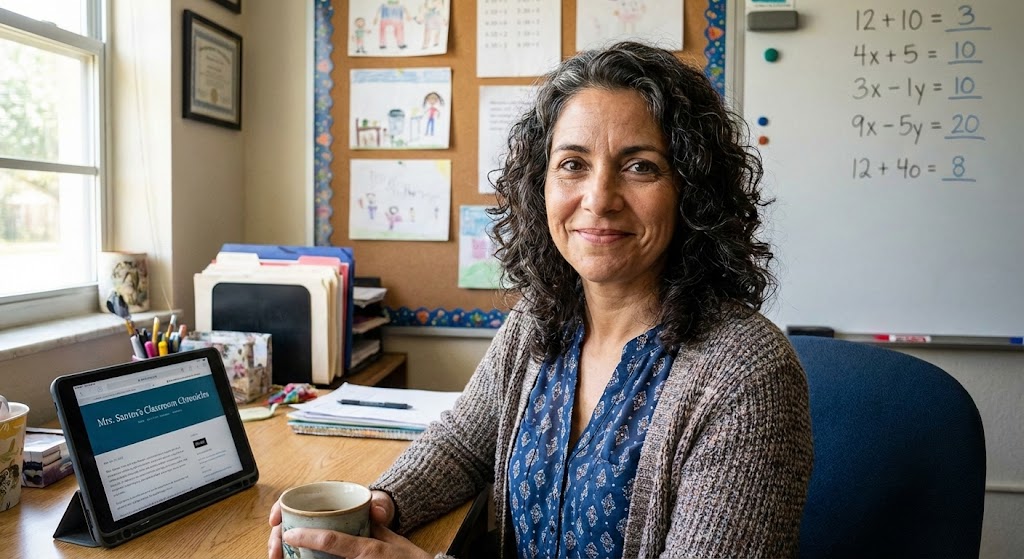
Maria Santos
Maria has been teaching 4th grade in Tampa, Florida for 22 years. Known as "the math whisperer" among her colleagues, she writes about the real challenges and victories of teaching in Florida's public schools.
When she's not grading papers or creating lesson plans, you can find Maria at her local teacher supply store (with coupons in hand) or sharing teaching tips over cafecito with her teacher friends.
View Full Profile →Related Articles
When Everyone's Brain is Already at the Beach (Including Yours)
Classroom management tip: Last Tuesday, I caught myself staring out the window during math, watching...
When May Hits and Everyone (Including You) Has Checked Out
Classroom management tip: Last Tuesday, I walked into my classroom to find three kids sprawled on th...
Ready to Improve Your FAST Scores?
Upload your class data and get personalized IXL success plans in seconds.
Try It Free